
What AI hype is and what reality looks like
Every company now says it is AI-powered. Vendors promise agents that run whole departments, apps built from one sentence and accuracy close to perfect. Leaders read the headlines, then look at their own operations and see a few people using a chat assistant.
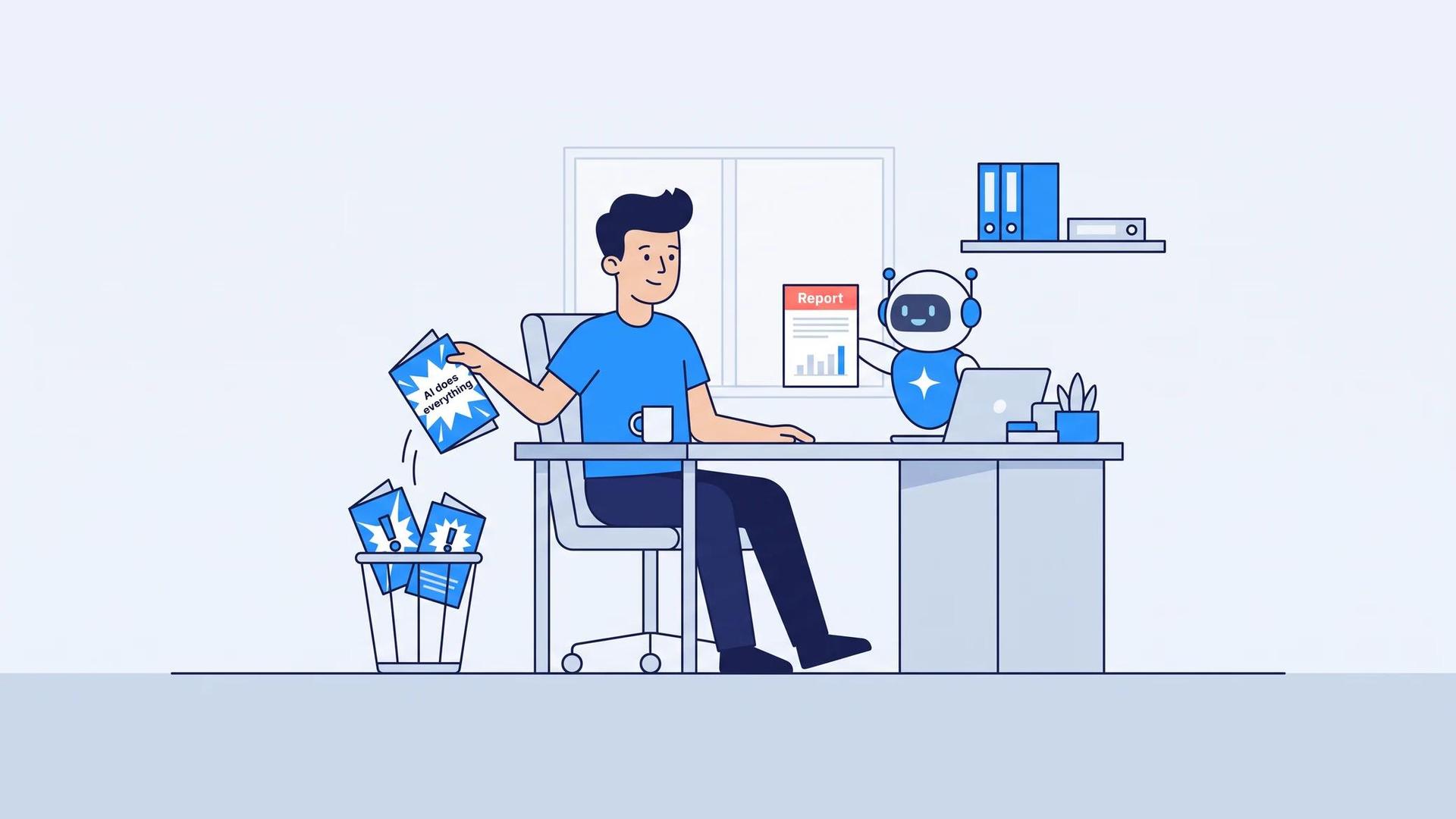
Both pictures are partly true. The models really are capable. The hype starts where a claim skips everything around the model: the process it works in, the knowledge it needs, the checks on its output and the people who run it. Reality is what remains once you add those back.
We are a technology consulting and engineering firm. We added AI automation to our own work once it became practical in real operations, and we use it every day. This is AI hype vs reality as we see it from that position: which promises fall apart, what actually runs and where AI in business is heading.
Why AI hype is so convincing
The hype is convincing because the demos are real. A model does summarize a contract in seconds, and a connector to a business system can be generated automatically from its API description. Adding an AI feature is cheap and quick to test, and that is a fair argument for trying things.
A demo shows one case on clean input. Daily work brings the other cases: the document in an odd format, the request that mixes two questions, the rule that lives in one person's head. A generated connector exposes a system's endpoints, while the work needs an interface shaped to the steps of the process. The distance between the demo and the daily work is where the hype lives.
We judge a new piece of AI work differently. Before we call it done, we run the whole chain once on a representative case, from the first input to the final result. A single feature that works in a demo tells us very little about the process around it.
Five AI promises that do not survive real work
"Describe it in one sentence and AI will build it"
A one-line request followed by magic makes a good demo and fails in real work. What works is a written specification first: what the result must be, what goes in and how to tell good from bad. AI then does the work against it, and a person who understands the work checks the result. In software this is spec-driven development, and the specification is only as good as the requirements and the architecture behind it.
"Our AI is 99% accurate"
An accuracy figure means something only when it was measured against a reference that people checked. A vendor's claim, a model's confidence score or a reviewer's impression is not a measurement. When you hear a percentage, ask what it was measured against, on whose data and on how many cases.
"AI will replace the team"
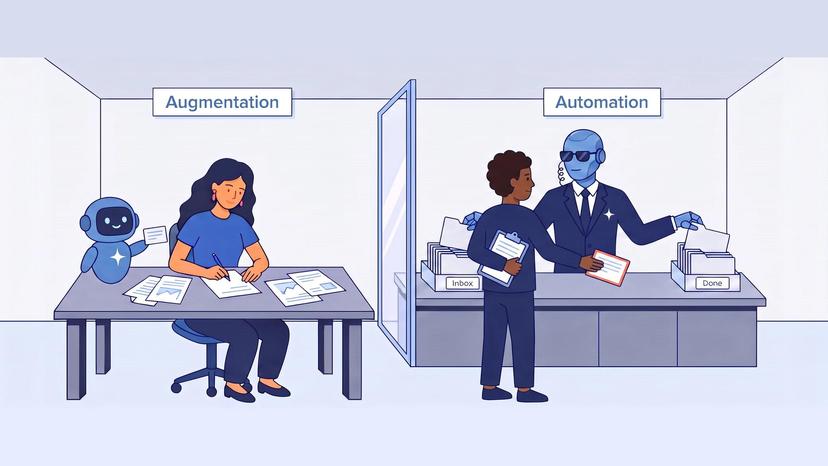
In the work we see, AI raises what the same team can deliver. Routine steps move to AI, and people keep the judgment, the approvals and the exceptions. There is a practical reason as well. The people who run a process know how it really works, including the exceptions nobody wrote down. Without them, the automation loses the knowledge it was built on.
"Agents will run the business on their own"
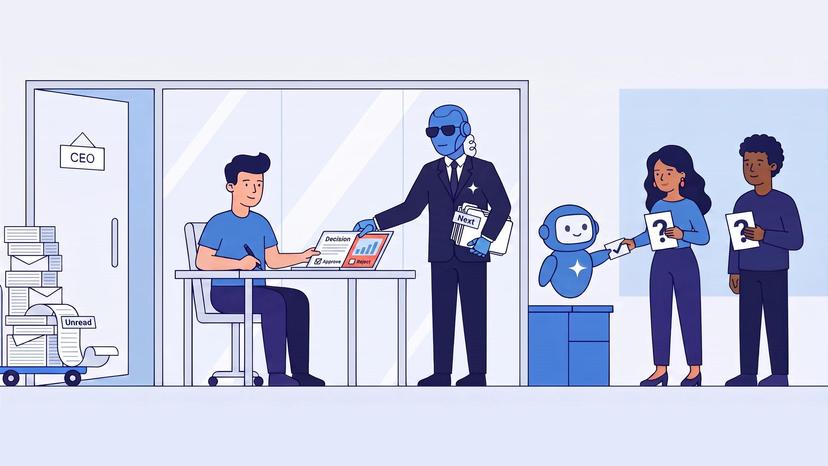
Agents already carry defined work end to end and pass the cases they cannot resolve to a person. At the most mature stage, verification agents check the work of production agents. Even then a check is only as good as the written standard behind it. People no longer review every result, but they decide the exceptions and oversee performance and policies.
"Buy the tool and productivity will follow"
Productivity is supposed to rise with every new AI tool. Without measurement, nobody can see the gain in the numbers. A team with a chat assistant on every laptop has bought tools. It becomes AI-powered when the tools sit inside a defined workflow and the people are trained to run it.
What actually runs in a business today
Take the promises away and the state of AI in business shows a clear pattern. AI is reliable today at work that has to be read and interpreted: an email, a contract, a support request, a scanned document. It classifies, extracts, drafts, summarizes and compares. It does this well when the step is defined, the knowledge it needs is at hand and someone checks what matters.
In practice, what runs looks like this:
- Assistants and skills that people use for a defined task, built from instructions that already gave good results.
- Agents that carry one defined process end to end and pass unclear cases to a person.
- Rule-based software for the structured steps, with AI on the parts that need interpretation.
- Connections to the business systems, which let AI read and act on real data instead of pasted text.
- Checks on the results that matter, with an escalation path when a check fails.
Two limits are worth knowing. The first is the physical world. AI plans the work, schedules it and manages the day. Cleaning a room, repairing a machine or serving a guest takes robotics and sensors, which is a different investment. The second is the process itself. Where a process lives in habits and exceptions, AI has nothing reliable to follow, and the first step is to write the process down.
Our guide to AI business process automation shows how these pieces fit together in operations.
What runs in our own company
Here is what runs in our own company today:
- We use several models side by side, ChatGPT and Claude most of all, Gemini and Perplexity now and then. Our agents and workflows run on our own infrastructure.
- Our skills and templates are written once and used across platforms and languages. They belong to us, and the choice of model stays open.
- Weekly reports for our account managers are fully automatic. The system collects the team's activity and writes the report with insights and action items. Nobody assembles it by hand.
- When we prepare a process for AI, we work in one order: define the process, make the templates, write the instructions AI works from, build the assistants, write the guides, run the whole chain once on a representative case, then train the people. Our tracker for this work has states called Review, Fix, Redo and Revise, because AI output gets reworked and we plan for it.
The model is the visible part. Most of our effort goes into the process, the templates and the checks around it. That is the honest picture of AI in a working company.
How to tell hype from reality in an AI pitch
When a vendor or a team shows you an AI result, five questions separate the claim from the result:
- What was the result measured against? Ask for the baseline before the change and the reference the numbers were checked on.
- On which cases? Ask how many real cases it ran on, whose data they came from and how the unusual ones went.
- What happens when it is unsure or wrong? A system that works in production has an answer: a check against a written standard, an escalation path and a log.
- Which steps does it take over? Ask to see them, and the steps that stay with your people.
- What happens when the technology changes? Heavy bets on one platform age quickly. The process, the knowledge and the quality criteria should stay yours, and the model should stay replaceable.
A demo rarely answers these questions. A system that runs in a real business answers all five. Once a claim holds up, approving the work is a separate decision, and the questions for it are in our article on AI for business leaders.
The future of AI in business
Predictions are the loudest part of the hype. We keep to the AI trends in business that we already see moving.
Products are expected to do the work. Buyers increasingly want AI inside the software they use. A product that leaves most of the work to the person in front of it draws less interest than one that does the work.
Interfaces get thinner. Business systems grew screens full of buttons because a person had to see the information and steer partly automated work. When a system can be given a goal and reach it, much of that interface is no longer needed.
Buying changes. More buyers ask an AI assistant to plan an automation and then to name the kind of specialists who can build it. Being found in those answers starts to matter more than advertising.
Autonomy grows in steps. Each area of a business moves from assisted work toward supervised agents at its own pace, once the previous stage gives a consistent result. A company where AI carries most of the execution and people direct it is a long-horizon goal. It is useful for setting direction and far from today's operations.
Through all of it, the business need comes first and the technology second. Tools will keep changing faster than any plan can follow. The processes, the knowledge and the quality standards a company builds will outlast them.
How EIC approaches AI in a business
We help companies put AI to work in three areas, each with its own site. AI-powered business process automation runs operations on AI. An AI-powered software factory changes how software gets built. Custom AI-native products are the software a business runs on. In all three we build on the processes a company already has and raise automation one controlled step at a time.
Want to check an AI claim against your own operations? Book a discovery call. You will talk with an engineer, and we will tell you plainly whether now is the right time.