What is AI augmentation?
AI augmentation means AI takes on parts of a person's work while the person stays in charge of it. You keep doing your job. AI handles pieces of it: a first draft, a calculation, a check against the rules, a summary of what changed, a list of options. You decide what to ask for, judge what comes back, use the result and answer for it.
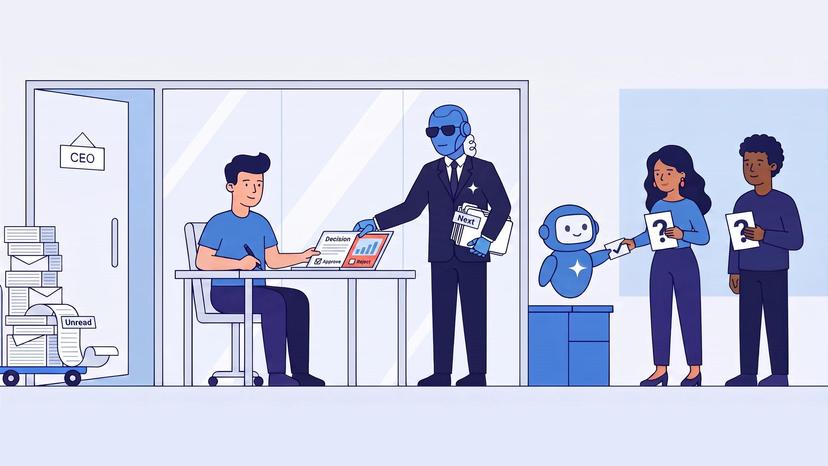
That is also the meaning of AI augmentation in our published framework of five levels of AI automation. At the first level the human stays the primary actor and uses AI to augment their efficiency. The AI suggests or generates pieces, and the person directs, reviews and puts them together. At the second level the AI drafts a whole plan or solution, and nothing moves until a person approves, corrects or redirects it. We count both levels as augmentation, because the work and the result stay with the person.
For a leader, this sets the right expectation. Augmentation raises what the same team can deliver, and your professionals keep the judgment and the authority. Handing the work itself to AI comes later, once the quality is proven.
What is the difference between AI augmentation and automation?
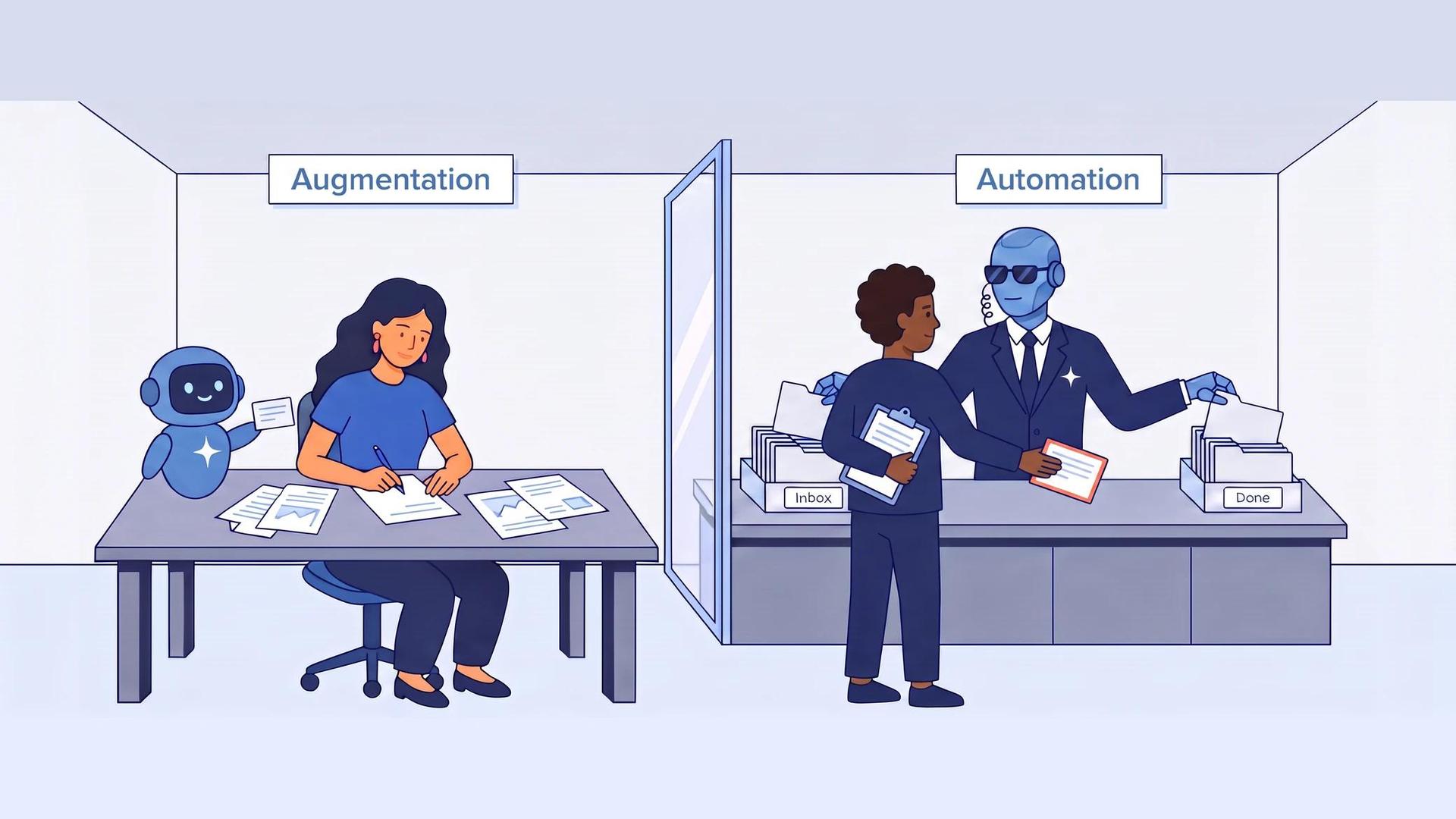
The augmentation vs automation question comes down to where errors get caught. With augmentation, a person sees every output before it's used. A weak draft costs a few minutes and a retry. With automation, the work moves on without anyone looking at each result. Errors have to be caught by controls, checks and escalation.
| AI augmentation | AI automation | |
|---|---|---|
| Who does the work | A person, with AI help | AI, while people oversee it |
| Who owns the result | The person who used the AI | The process owner, through control points and escalation |
| How good the AI has to be | Good enough to save time: half of its outputs useful on small tasks, more than 70 % of its proposals right on whole solutions | 90 % success or more under supervision, near-total reliability within its scope without it |
| What an error costs | A rejected draft and a retry | A wrong result that reaches a customer, a system or the next step |
| What has to exist first | A person who knows the work | A proven process, written quality criteria and monitoring |
These figures come from our own model, explained in When is AI good enough?. They show why augmentation and automation can't be judged by the same yardstick. An assistant whose proposals are right three times out of four clears the bar when a person checks each proposal. An automated process with the same error rate would let one result in four go out wrong.
How oversight works once AI does the work is a design question of its own. We cover it in Human on the loop.
Why augmentation pays off before AI is fully reliable
A common belief holds that AI has to solve a task completely on its own, or it's useless. It's a costly misconception. It makes leaders wait for a level of reliability that augmented work doesn't need.
The arithmetic is simple. Take the time a person needs to do a task by hand. Then take the expected time with AI: preparing the request, generating the result, checking it, then fixing or retrying when it falls short. If the second number is smaller, AI is worth using, even when some outputs end up in the bin. Short tasks that are quick to check clear this bar early. As tasks get longer and the AI works with less guidance, checking and fixing take longer, and the bar rises sharply.
That's why augmentation can start long before the same work could be automated. Documents are a good place to begin. Most knowledge work is writing and processing them, and they're one of the main ways knowledge moves through a company. Small gains there add up across every team.
How human-AI collaboration splits the work
Human-AI collaboration in the workplace holds up when the split is written down. Leave it to each person's habits, and the result depends on who did the work.
In the assistant briefs we're writing, every assistant has three parties with their own duties:
- The assistant does the repetitive part. It inspects the material, runs the checks and drafts proposals.
- The person using it sets the scope, approves the changes and stays responsible for getting it right.
- An owner keeps the rules, the permissions and the reference material up to date. That keeps the assistant in step as the business changes.
The brief also spells out where the person steps in:
- Goal alignment. The assistant confirms the scope and the acceptance criteria before it starts.
- Permission. It asks before running an action that changes something.
- Draft review. It stops to show what it proposes next to what exists.
- Correction loop. It adapts to the person's comments and carries them forward.
- Uncertainty. It stops and asks when its sources conflict.
- Escalation. It hands control back, with the evidence, when it runs out of attempts.
Authority comes in three tiers: what the assistant may do on its own, what needs approval and what is blocked. One named person stays accountable. On top of that we apply one rule: an assistant may review another assistant's work, but its review never replaces a person's approval where the process requires one.
AI augmentation examples from our client work
Here's what human-AI collaboration looks like in practice. The cases come from our interviews and project work, with names removed. In each one, AI takes a defined part of the work and a person keeps the judgment.
- A small machine shop. The owner uses a general AI chat for reference calculations and preliminary quotes. A coding assistant writes simple lathe programs from a spec: tool, speed, material, number of passes. The check is a toolpath simulation. Complex 3D work stays manual, because there's no check that simple for it. How far augmentation goes depends on how the result can be verified.
- Customer service at a retailer. When a customer says a package never arrived, the team checks the carrier's delivery photo. Whether to offer a goodwill discount is a judgment call that lives in the team. This is the kind of work we'd give an assistant: gather the evidence, apply the written part of the policy and propose a resolution. The goodwill decision stays with the person handling the case.
- Reviews at a home-services company. Every customer review gets a reply. The manager personally reads every review of three stars or below. An assistant can draft the replies, and a triage rule sends the low ratings to the manager.
- Estimates in the field. Technicians estimate jobs by a set of rules and may go higher or lower after their diagnosis. An assistant that drafts estimates has to treat the rule as the default, and the technician keeps the latitude.
- Code review in a software team. In a reference design we're writing, an assistant runs the repetitive cycle of tests, style checks and build fixes. The engineer keeps the architectural decisions and the final merge.
Augmentation and automation are one path
Each piece of work moves from augmentation toward automation as it proves itself. That's how it goes in our projects.
While people work with AI, the main flow gets proven, the edge cases surface one by one, and the instructions the AI needs get written. At the collaborative step the person stops writing prompts. The assistant already knows the process, and the conversation is about the case at hand. Only when the tasks are well tuned and even the edge cases raise no questions does an agent take over. Even then it starts under supervision: a person makes some of the decisions and checks the results.
Different areas of a company sit at different points on this path at the same time. A system can also step back. A supervised AI that runs into a situation calling for human judgment should drop to the approval level, propose and wait, instead of guessing. We describe the path as four stages of AI autonomy, from Assisted to Autonomous. Each stage is extended only after the previous one gives a consistent result.
What an AI-augmented workforce needs
Handing every employee an AI tool starts augmentation. Three things decide whether it holds up.
- Defined work. When a process lives in habits and exceptions, AI has to guess how it should run. Each person then gets a different result from the same tool.
- Reachable knowledge. When know-how sits in people's heads or is spread across systems that don't talk to each other, AI answers from part of the picture. We cover how to capture it in Tribal knowledge.
- Review capacity. AI raises the volume of output faster than a team's ability to check it. When the definition of a correct result stays vague, review becomes the bottleneck and errors slip through. Written acceptance criteria, and an owner who keeps them current, keep review in step with volume.
Where the gain from augmentation goes
Augmentation frees up capacity, and leadership has to decide where it goes. In our client conversations so far, the answer has been growth. We asked an engineering leader what the teams would do if their productivity doubled. The answer: more functionality. Another company plans to raise its team's productivity first and then spend the freed capacity on new product work and on modernizing its systems. In these cases the impact of AI on the workforce shows up as capacity, and the company decides how to use it.
You'll only see the gain if you measure it. Productivity is supposed to rise as AI takes on more of the work, yet nobody can see the change in the numbers without a record of where time goes. A baseline taken before the change makes the result provable later.
Whether automation means fewer people is a separate question. We answer it on our business process automation site: does automating business processes mean replacing employees?
How EIC approaches augmentation and automation
We treat augmentation as the first stretch of the road to automation. Our rule, on our home page and in our approach, is simple: increase autonomy only after quality is proven.
In business operations, AI Execution Assistance turns recurring AI-assisted work into skills and producing assistants that people use every day. Their inputs, instructions, knowledge, outputs and boundaries are defined once. When a process is proven and its quality criteria are written down, AI Agentic Execution lets an agent own it end to end, inside control points your organization defines. In software delivery, we apply the same order when we turn the way a team builds software into an AI-powered software factory.
Want to know which of your work is ready for an assistant today, and which could go further? Book a discovery call. You'll talk with an engineer.