What is AI leadership?
Most of what's written about AI leadership is about other people's work: which teams should use AI, which processes to automate, which tools to buy. That's part of the job. The other part starts closer to home. A leader is also someone whose own week fills up with work that AI could prepare.
So AI leadership has two sides. One is your own work: the reports, approvals, questions and loose ends that reach your desk, and the decisions that only you can make. That's AI-augmented leadership, the same idea as AI augmentation applied to the leader. The other side is the company: the targets you set, the measures you watch and the conditions you create for the teams that put AI to work.
Why AI for business leaders starts on their own desk
In several small companies we've interviewed, the owner is the busiest node in the business. In one firm, when we went through the functions one by one and asked who handles each, the answer was mostly the owner. The owner of a furniture workshop handles marketing, takes the orders, measures, designs, quotes, writes the contracts and the invoices and orders the materials. Half of the company's functions run through one person.
The time goes to things that look small. The owner of a machine shop told us the hours disappear into people and communication rather than production. Everyone comes straight to the owner: someone is sick, someone didn't understand a drawing. Asked what to change first, the owner didn't name a technology. The wish was for someone to chase the loose ends, to free up time for planning and for clients.
That's where AI for a business leader starts. Some of that load is simple escalation that clear instructions and an assistant can absorb. The part that's about people stays with people. Sorting the two is the first thing a leader can do with AI, and it starts with an honest look at where the week goes.
Take the repeat questions off your desk
Many of the questions that reach a leader have been asked before. One owner we interviewed is testing a direct answer to that. First, everything the company had written down went into one place: the documents, the sales scripts, the basic instructions for staff. Then an AI agent joined the managers' chat, connected to the order sheets, to answer questions such as where a given order stands.
The same owner went one step further. The whole history of the team chat went to a model, which listed the disputes that kept coming back and how each one had been settled. The hope is that the person who settles them today won't have to step in every time. It's an experiment, and the owner says so. The order is right, though: collect what the company already knows, let AI answer from it and keep the judgment calls for yourself.
AI for CEOs means deciding on prepared cases
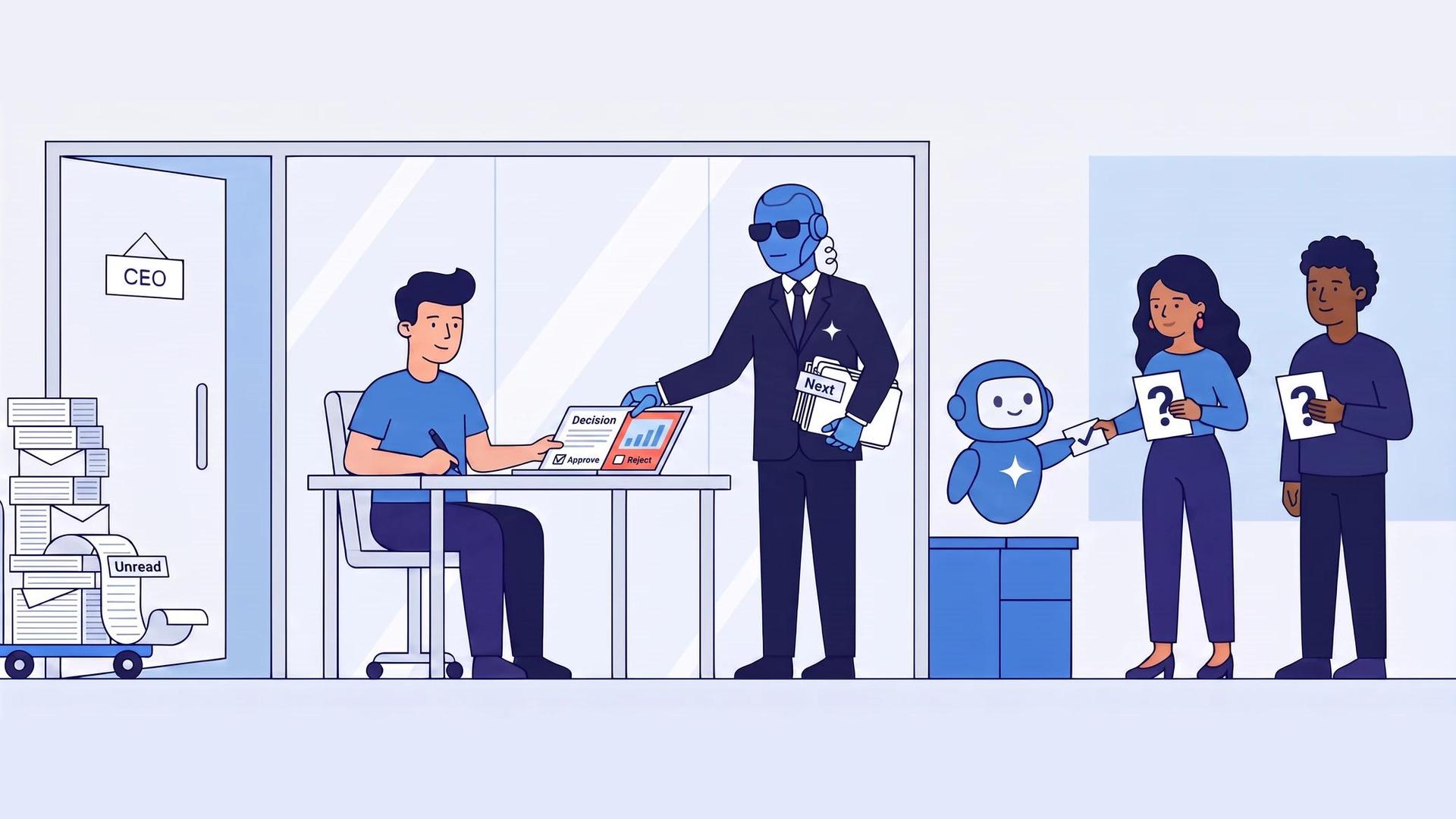
At the top of a larger company the pattern is different but the fix looks similar. At one retailer, every commercial account application lands in the CFO's inbox, and the CFO has to read and approve each one. The goal our interviewee there described: the application goes through a workflow, a system works out a recommended credit limit with its reasons, and the CFO only makes the call.
That's what AI changes for a CEO or any other leader. The decision stays yours. The reading, gathering and first draft of the reasoning no longer have to be.
The same goes for the documents a leader reads. Writing and updating documents used to be expensive. One big document had to serve everyone, and few people read it. With AI a team can keep a few key documents current and produce a short brief for each reader: the tester, the developer, the executive. You get the version written for your decision.
Turn meetings and reviews into prepared work
Leaders spend part of every week in routines that someone prepares by hand. In one large engineering organization, people update the status of every project in red, yellow and green manually, and the weekly operations review starts with collecting service metrics from each system. Both are reports that AI can prepare. The meeting then starts with the analysis.
Meetings produce work too. At one retailer, the team wants a request voiced in a meeting to turn into a ticket on its own. An agent that knows the project writes the ticket from the conversation. The manager in charge approves it before any work starts. The leader's role stays the same. You decide what goes ahead. The writing up is what changes.
Set the target and leave the method to your managers
One of the clearest AI leadership examples we've seen came as a mandate from the top. A division head was given a target: double the team's productivity, then double it again. How to get there was up to the manager. The baselines already existed, and the result would be judged on throughput, on whether removing the bottlenecks actually moved more work through.
Three things make a mandate like this work. The target is a business result. The measure is agreed before anyone starts. The method stays with the person who knows the work. Leave out the measure and you can't tell whether AI helped. Prescribe the tool and you take the decision away from the people who'd have found the real bottleneck.
Agree the gates and let teams work between them
A large corporation we work with runs its engineering this way. It regulates the outcomes and the gates: how defects are reported, which milestones a product must pass, which functions must sign off. How a team works between two gates is its own business, and the choice of technology isn't regulated at all.
That's a useful model for leading AI work, at the board level as much as in a department. Agree the gates and the evidence each one needs: the result, the quality check, the sign-off where an error would be costly. Then let the teams choose how they use AI between the gates.
Ask for the process before the tool
We once put the order to an engineering director in one line, and the director agreed at once: a solid base comes first, and higher productivity from AI is the cherry on the cake. The base means repeatable processes, consistent designs and standard work products. Without them AI speeds up whatever is there, inconsistencies included.
For a leader, this turns into a question to ask before approving any AI initiative: is the work it touches written down? Our usual sequence with a sponsor is to document how the work runs today, show where the gaps are and let the sponsor decide which gaps to close. Only then do we talk about automation. The leader's decision sits in the middle of that sequence. It can't be delegated to the tool.
Be clear about what you want from the business
AI is a means. The leader's goal comes first. When the owners of one small manufacturer sat down with an income target and asked what they'd need to reach it, their own list ended at the same place: records and automation. Nobody had to sell them a tool.
Not every leader wants growth, and that's a legitimate answer. One owner told us plainly: no plans to expand, just a business run at a slower pace. For that owner, AI is about time and steadiness. We start every conversation with the leader's goals for that reason. The same tools serve very different aims.
Let your own people lead the work
One sponsor we've worked with asked for something we'd recommend to any leader. Instead of handing the whole job to us, the sponsor wanted the company's own technical leaders to drive the discovery work and learn to lead it. Our role was to check what they produced. That gave the sponsor a result to trust.
That's AI for leadership development in a practical form. The people who will run the work afterwards build their own understanding while they do it, and the leader gets an independent check without giving up ownership. It also keeps the knowledge inside the company, where it'll be needed after any outside team has left.
Questions to ask before you approve an AI initiative
Put together, the sections above become a short list for any AI proposal that reaches your desk:
- What business result should this change, and how will we measure it?
- Is the work it touches written down, and who decided which gaps to close?
- Who checks the results, and where does a person sign off?
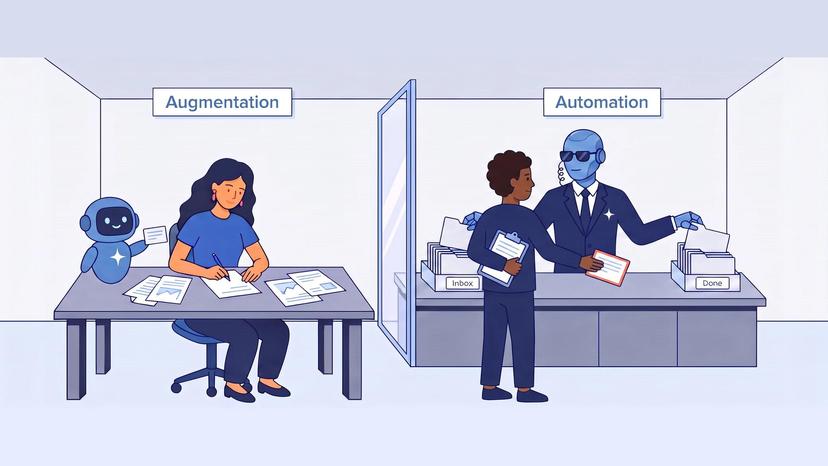
- If it frees up time, where will that time go? We wrote about that choice in AI augmentation vs automation.
- Who on our side will lead it, and how will they learn to?
How EIC works with business leaders
We start with a conversation about your goals and your week, with an engineer rather than a salesperson. If the next step is a plan for the whole company, AI Organization Strategy builds it: how the business runs today, the target it's moving toward and the roadmap between them. Its FAQ answers the common questions about AI strategy, readiness and where to begin. If you lead an engineering organization, AI Software Engineering Strategy does the same for software delivery.
Want to see where AI could take work off your own desk? Book a discovery call. We'll tell you plainly whether now is the right time.